mark-elliott.net

work, research, family, art … life
  • rss
  • Home
  • about
  • My PhD
    • PhD Examination Reports
    • 0. Prelude: Meta Contexts

Re: Ignorance bliss when it comes to sharing

mark | 17 October 2007 | 12:01 pm

I was recently asked to comment for a newspaper article on the selling of xpmediacentre.com.au’s web infrastructure (an online media support community) by the owner of the site’s domain to internet video provider, RealTime.

My response and the article can be seen here on The Age (Melbourne), and also on the Sydney Morning Herald.

While I am happy with the general gist of the article, I just wanted to make one correction and add a few additional thoughts. The fact that I have already submitted my PhD for examination and have just submitted my final approved version for publication (as seen in my previous post) some how got lost in the mix – no big deal I suppose.

I principle I agree with the final statements of the piece:

…in Melbourne last week at a Churchill Club meeting, an industry discussion on the economics of Web 2.0, the consensus was “who does it hurt?” If a site provides a good service and has enough users, few care who owns it or why.

“The best that can happen to (an) application is to be bought by Google or Yahoo!,” says Deloitte Digital chief executive Peter Williams. “You get zealots who complain.”

Quick-links managing director Sean Kelly agrees: “Passionate users are one in 50 people – the other 49 don’t give a rat’s arse.”

It’s no great surprise this would be the outlook of an ‘innovation and entrepreneurship forum‘ (but of course not all online communities share these values or objectives). Also, I’d like to add that according to the notion of the 80/20 rule, otherwise known as the Pareto principle, it is likely that the one in the 49 will be just the person providing some of the most valuable, high quality material or contributions to the community. I would also argue that the success of the largest mass collaboration to date, Wikipedia.org, is due precisely to its ‘zealots’ (only a few in comparison to the overall contributors) who work tirelessly behind the scenes to help generate one of the world’s more influential information sources – I know just how many undergraduate university students are turning to it as an entry point for their research assignments.

So perhaps such concerns – whether or not your community will be sold out from under you and what implications this might have – may be different for different kinds of communities. Communities such as MySpace, Facebook and xpmediacentre may be less concerned about such issues as perhaps their contributions are more ephemeral and based in discussion, while a project such as Wikipedia may need more explicit licensing in order to assure its users that they will always have access to their contributions (which may be similar to other knowledge generating projects who’s output is oriented towards more lasting artifacts – such as scientific and academic research endeavours etc).

Regardless, it is an interesting issue which will no doubt feature in years to come – how will you feel when your favourite social networking platform goes belly up or trades hands and all your communication (the intelligence and interactions you and your peers have rendered upon the platform) disappears with it too? What if this information and development is used by someone else to make a few bucks, and you’re left out in the cold? Can you even export your Facebook encodings (I don’t know)?

To me, this makes a good case for a kick-ass open source, open access social networking platform (think Facebook meets Firefox meets Wikipedia). Hmm, I bet there’s already one out there just waiting…

This content is also mirrored at my other blog, Mass Collaboration.

Tech Tags: phd socialmedia masscollaboration
Comments
No Comments »
Categories
research, work
Tags
masscollaboration, phd, socialmedia
Comments rss Comments rss
Trackback Trackback

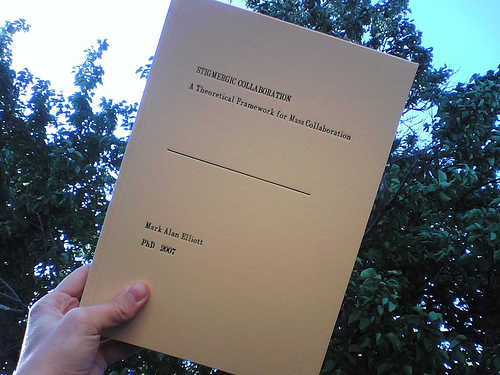
PhD Completed!!!

mark | 15 October 2007 | 7:14 pm

Examined, bound and submitted – and what a good feeling it is!

Stigmergic Collaboration: A Theoretical Framework for Mass Collaboration

I thought I might provide a general overview of my dissertation for those interested.

I was supervised by Elizabeth Presa, Sean Cubitt and Warren Burt and was examined by Howard Rheingold and Francis Heylighen. You can read the examination reports here.

Abstract (first paragraph)

‘This thesis presents an application-oriented theoretical framework for generalised and specific collaborative contexts with a special focus on Internet-based mass collaboration. The proposed framework is informed by the author’s many years of collaborative arts practice and the design, building and moderation of a number of online collaborative environments across a wide range of contexts and applications. The thesis provides transdisciplinary architecture for describing the underlying mechanisms that have enabled the emergence of mass collaboration and other activities associated with ‘Web 2.0′ by incorporating a collaboratively developed definition and general framework for collaboration and collective activity, as well as theories of swarm intelligence, stigmergy, and distributed cognition.’ >> full abstract

The core insight of the thesis is that mass collaboration (Wikipedia, open source software, Second Life etc) enables a shift from social to cultural negotiation, shattering the traditional glass ceiling of collaborative participation from approximately 25 members maximum, towards hundreds of thousands and beyond.

Social negotiation is the means by which all traditional collaboration takes place and is characterised by turn-taking communication. In the case of mass collaboration, a digital workspace mediates participant interaction, providing stigmergic cues to negotiate contributions via the various literacies associated with digital technologies and the particular workspace’s norms, languages and ‘netiquette’. While this does not preclude turn-taking communication, it places the interactive focus on cultural information which serves as the first point of engagement.

In other words, the workspace acts as a boundary object that removes social barriers to participation in online contexts (establishing, negotiating and maintaining social relations with thousands of people) and streamlines the creative process through providing a single site of work to a theoretically infinite number of participants.

Many other themes and sub-frameworks contribute to the overall work such as (note: sorry, the links in this list are busted - i will endeavour to fix soon!):

  • an in depth review of the state of stigmergy research and applications;
  • a original, general theory of collective activity;
  • an etymologically researched, cross-disciplinary, collaboratively informed definition of collaboration and the beginnings of a general theory of collaboration;
  • a framework for understanding indirect, mediated communication;
  • the documentation of a number of real-world projects which apply and test the findings of the thesis;
  • and of course, a framework for mass collaboration which integrates the above as well as preexisting frameworks and theories.

The dissertation may be downloaded here (a 30MB, 242 page PDF).

I would love to hear your opinions, so please feel free to comment!

[note: this post is also mirrored my other blogs Stigmergic Collaboration and Mass Collaboration.]


technorati tags:
phd
collaboration
mass collaboration
stigmergic collaboration
stigmergy

Comments
3 Comments »
Categories
research, work
Tags
collaboration, masscollaboration, phd, stigmergiccollaboration, stigmergy
Comments rss Comments rss
Trackback Trackback

blog posts

  • art (4)
  • personal (15)
  • research (29)
  • work (18)

tags

Add new tag art cedar&lucas censorship collabforge collaboration collectiveaction computing conferences cooperation education future gov20 internet masscollaboration newmedia OpenGov p2p paretoprinciple phd published socialmedia stigmergiccollaboration stigmergy technology wiki

archive

  • May 2009 (2)
  • March 2009 (2)
  • December 2008 (1)
  • October 2008 (3)
  • September 2008 (1)
  • August 2008 (1)
  • July 2008 (1)
  • June 2008 (2)
  • May 2008 (2)
  • February 2008 (3)
  • January 2008 (3)
  • December 2007 (2)
  • October 2007 (2)
  • September 2007 (1)
  • August 2007 (2)
  • June 2007 (1)
  • April 2007 (1)
  • January 2007 (2)
  • December 2006 (3)
  • November 2006 (2)
  • October 2006 (4)
  • August 2006 (1)
  • July 2006 (1)

Meta

  • Log in
  • Entries RSS
  • Comments RSS
  • WordPress.org

comments

  • LLOYD on Twitter Spreads Ideas Like Air Travel Spreads The Flu
  • KENNY on Twitter Spreads Ideas Like Air Travel Spreads The Flu
  • FERNANDO on Twitter Spreads Ideas Like Air Travel Spreads The Flu
  • JEROME on One Web Day & Future Melbourne
  • LUKE on Daintree Daydreaming…

CO2Stats.com

Welcome

to my digital homestead:
blog, other stuff, and a sprawling wiki behind the scenes.
Feel free to contact me.

Email: me AT mark-elliott.net
Twitter: MarkElliott
Del.icio.us: MarkElliott

twitter

OneWebDay 2009!


Visit my.OneWebDay

recent publications

  • Stigmergic Collaboration: A theoretical framework for mass collaboration (my PhD)
  • Australian bill of rights initiative: collaborating on public policy
  • Stigmergic Collaboration: The Evolution of Group Work
  • Growing Large-scale Collaborative Organisms...

blogroll

rss Comments rss valid xhtml 1.1 design by jide powered by Wordpress get firefox